Tech Meetups & Hackathons in Neubrandenburg
Tech Meetups & Hackathons in Neubrandenburg: How Upcoming Formats Can Connect Research, Bioeconomy, and Digital Participation
Brief overview: This article provides practical insights on how Neubrandenburg can build meetups, hackathons, and workshops in the future – with a focus on bioeconomy, urban development, and open innovation.
Digital Ideas: Why Neubrandenburg Can Work as a Tech Lab
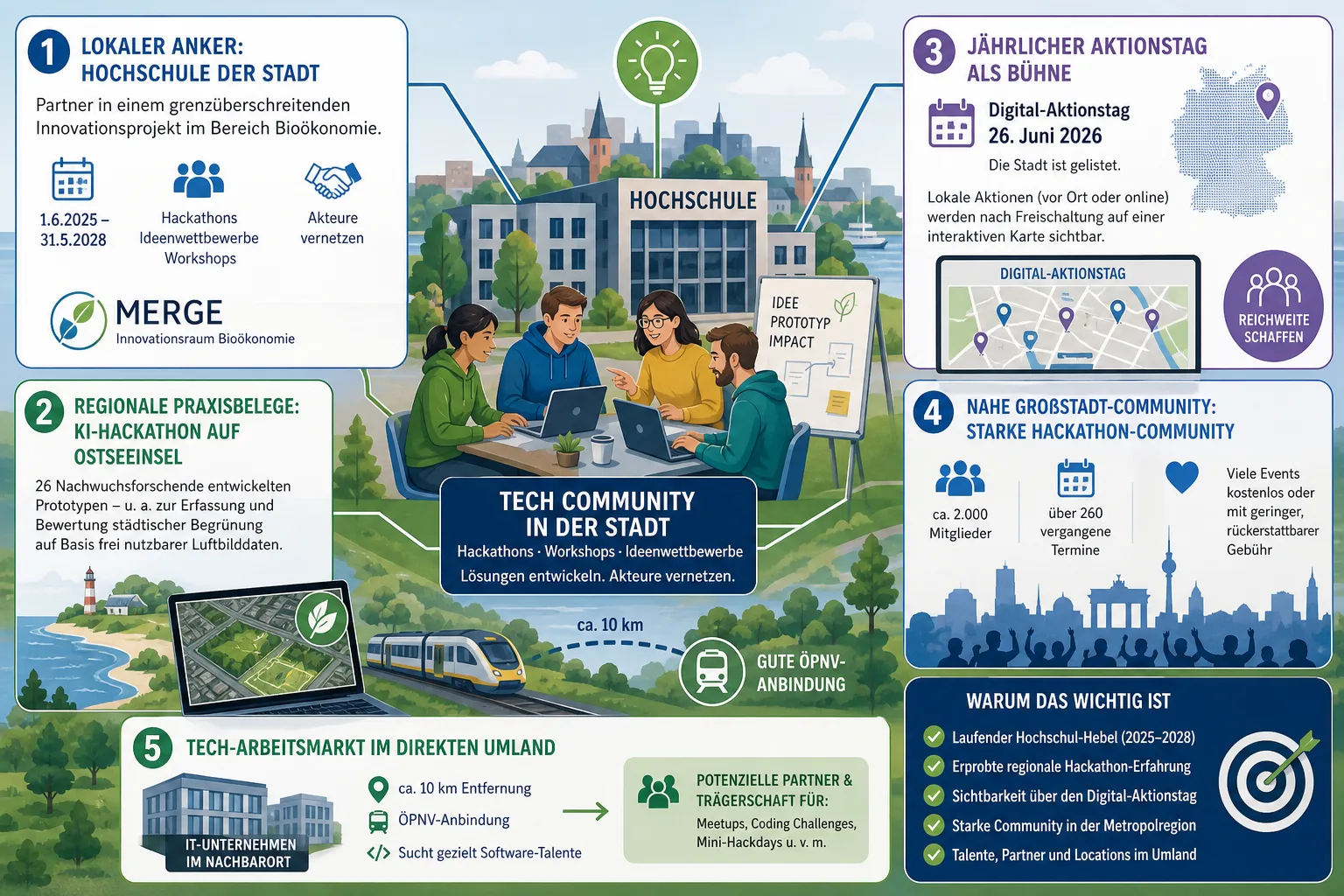
Neubrandenburg can become a vibrant tech lab for the region in the future – not because it "has to be the next big startup hub," but because concrete local topics (urban greenery, mobility, regional value creation, administration, education) are ideal for hackathons, meetups, and workshops. These formats bring students, researchers, companies, administration, and the urban community together at one table in a short time – turning abstract digitalization into tangible prototypes.
The key is a realistic expectation: A hackathon does not have to deliver a finished product right away. Its value often lies in joint problem clarification, in initial prototypes, and in new partnerships that continue to work together afterwards.
University as a Driver: Bioeconomy, Open Innovation, and Practice-Oriented Formats
For future tech formats in Neubrandenburg, the university is an obvious anchor: research and teaching can provide topics, data spaces, methodological expertise, and spaces – while practice partners bring in real challenges. Projects in the field of bioeconomy are particularly suitable, as scientific, economic, and digital perspectives converge there.
What does this mean for upcoming events?
- Workshops before the hackathon: The problem, data situation, and target vision are sharpened together (e.g., "What by-products are generated?", "What decisions should be supported?").
- Hackathon (24–48 hours): Teams develop prototypes such as dashboards, simple apps, data pipelines, visualizations, or service concepts.
- Demo session & transfer: A jury from research, administration, and practice evaluates based on criteria such as usefulness, feasibility, comprehensibility, data protection, and sustainability.
- Follow-up work (4–12 weeks): The best approaches receive mentoring, access to test environments, or small implementation budgets (e.g., through support associations, sponsorship, or project funds).
Why Bioeconomy Works Well as a Guiding Theme
Bioeconomy aims for sustainable value creation with biological resources – and therefore opens up many data-driven questions: material flows, use of residual materials, regional supply chains, energy and emissions indicators, or transparency in supply. For hackathons, this means: There are concrete metrics, real processes, and visible impact.
Topics for Upcoming Hackathons: From Urban Greenery to Data Literacy
To keep a hackathon from becoming "too big," a clear thematic corridor helps. For Neubrandenburg, the next formats are particularly suited to topics that are locally relevant, data- or user-oriented, and can be prototyped in a few days.
Ideas That Can Be Well Tested in Neubrandenburg in the Future
- Smart Urban Greenery & Climate Adaptation: Maps/analyses for heat islands, shading, quality of stay, maintenance needs of green spaces; understandable visualizations for citizen dialogues.
- Regional Nutrition & Supply Chains: Prototypes for better visibility of regional products, demand planning, food waste reduction, or small-scale logistics optimization.
- Open Data & Civic Tech: Workshop series "Learning to Read Open Data"; followed by a mini-hackathon that develops citizen services or information offerings from datasets.
- Hands-On Digital Administration: Form improvement, accessibility, appointment and process overviews – always with a real user journey and feedback loop.
- Education & Participation: Beginner track (e.g., "first API," "first map," "first analysis") plus a track for advanced users (data quality, automation, modeling).
This Is How an Idea Becomes a Good Hackathon Challenge
- One-sentence goal: "After the weekend, we can decide/see/achieve X better."
- Clear user: Who will use the result the following Monday (administration, operations, school, citizens' initiative)?
- Provide materials: Datasets, sample CSV, documentation, contacts, terms of use.
- Success criteria: Comprehensibility, usefulness, feasibility, data ethics/data protection, maintainability.
Digital Day & Other Occasions: Visibility for New Meetups and Hackathons
For upcoming formats, visibility is an accelerator: If there is a date, a place, and a registration page, people are more likely to come. The nationwide Digital Day can serve as a stage for this in the future, as actions can be published and made findable there. In addition, semester starts, city festivals with an educational focus, or theme weeks (e.g., climate, sustainability, science) are good occasions for first pilot formats.
A Proven Format Set for a "Tech Day" (in the future)
- 60–90 minute meetup: 2 short talks + 1 project pitch + open Q&A session.
- Mini-workshop (beginners): "Understanding data" or "Prototyping without prior knowledge."
- Mini-hackathon (4–6 hours): 2 challenges, mixed teams, clear demo slots.
- Conclusion & next steps: Who will continue, when is the next meeting, what contacts are needed?
Important: Low-threshold does not mean arbitrary. A curated program, clear contacts, and a transparent process ensure that new participants can also find their way.
Attracting Talent: Cooperation, Mentoring, and Regional Employers
For meetups and hackathons to grow in the coming months, roles are needed – not just "participants." Particularly effective are collaborations between the university, associations, administration, and employers in the region.
Roles That Can Make a Format in Neubrandenburg Stable
- Hosts (organization): Date, venue, registration, process, moderation.
- Challenge owners (practice): Bring a real problem, data, and decision context.
- Mentors: Support teams with methodology, architecture, UX, data quality, pitch.
- Jury/advisory board: Evaluate transparently and provide follow-up options (pilot, internships, project seminars).
- Community care: Ensure a welcoming culture, low barriers, code of conduct.
Employers can meaningfully support future formats without "taking over": with mentoring, technology budgets, spaces, small prizes, or the promise to test good prototypes in pilot projects. This creates a recruiting side effect that is fair for both sides: Participants retain control over their contributions and see clear next steps.
Roadmap for the Next 6–12 Months: How an Idea Becomes a Recurring Format
A sustainable ecosystem rarely emerges from "the one big event," but through repetition and reliability. The following roadmap is designed for the next few months and can be implemented by a small core group.
Phase 1 (Months 1–2): Start with a Regular Meetup
- Fixed rhythm: e.g., every 1st or 3rd Thursday of the month.
- Always the same basic format: Arrival → short inputs → Q&A → networking.
- One clear channel: Newsletter or event page, plus a permanent contact (email).
Phase 2 (Months 3–6): First Pilot Hackathon with Two Challenges
- Maximum two topics: reduces complexity, increases result quality.
- Pre-briefing (possible online): Data, goal, criteria, legal framework.
- Demo night: Public presentation, including "What happens next?"
Phase 3 (Months 6–12): Consolidation & "Lead Hackathon"
- Guiding theme: e.g., bioeconomy & regional value creation, supplemented by a cross-cutting urban topic.
- Partner network: 3–6 permanent supporters (spaces, data, mentoring, communication).
- Documentation: Results (code, slides, demos) are centrally collected and made findable.
Guardrails for Trust & Participation: Data Protection, Fairness, and Transparency
For future tech formats in Neubrandenburg to be sustainable, they must be trustworthy. This is especially true when data is used or when results have an impact on administration, education, or supply contexts.
Recommended Standards for Upcoming Meetups & Hackathons
- Code of conduct: Clear rules for respectful interaction, contact persons, consequences.
- Data protection & data ethics: Only use data whose origin and use are permitted and documented; be especially careful with personal data.
- Transparent evaluation: Publish criteria in advance (usefulness, feasibility, comprehensibility, sustainability).
- Clarify rights: Define in advance how contributions are licensed (e.g., open licenses) and how partners may further use results.
- Plan for low barriers: Design language, spaces, time slots, and roles so that beginners can also participate meaningfully.
Note (not legal advice): This article provides organizational guidance and does not replace legal advice, especially regarding data protection, licenses, or contractual issues.