Sports Events & Running Events in Neubrandenburg
Sports Events & Running Events in Neubrandenburg: Your Outlook on Upcoming Dates
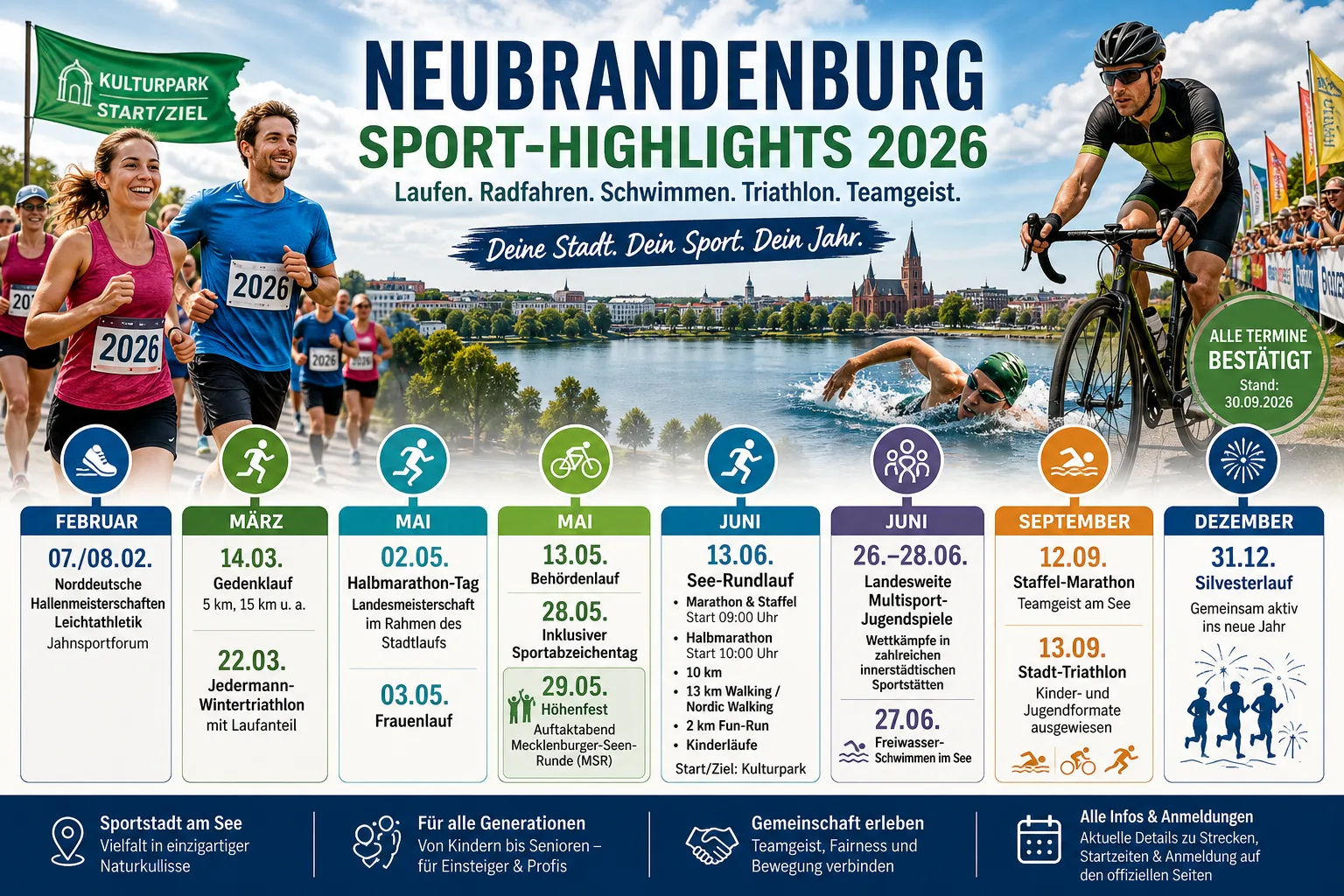
Neubrandenburg also offers a dense sequence of running and endurance events in the coming months and in the next sports season – from the early season start, through major formats around Lake Tollense, to the athletic year-end finale. This overview helps you classify upcoming events, plan sensibly, and find reliable sources of information for registration, routes, and safety rules.
The Sports Year Arc: How Upcoming Events Are Structured
If you are planning your season in Neubrandenburg, a simple principle helps: Most endurance formats can be structured along a yearly arc – from the early form test to the emotional year-end. Which specific dates take place next depends on the respective event year. Therefore, the publications of the organizers and the official date overviews are always binding.
- Early Season Start: Indoor or track competitions as well as first road and cross-country runs as a form check.
- Spring and May Phase: Runs near the city center (often with a thematic focus such as women's/team formats) and the first large starting fields.
- Early Summer: Longer distances and "classic" endurance events around Lake Tollense.
- Summer: Open water and multisport formats, often with family and youth starts.
- Autumn: Team and relay events as well as triathlon formats suitable as season highlights.
- Year-End: A low-threshold run at the turn of the year (e.g., New Year's Eve run).
For participants, this means: You can adapt your training build-up (base → speed → volume → peak) very well to the upcoming events without having to change location for every performance class.
Spring: Season Start on Track, Road, and Trail
Indoor and Championship Formats: Short Distances, High Intensity
At the beginning of the sports year, indoor or compact stadium formats are often found in Neubrandenburg and the region, where sprint, jump, and running disciplines take place in quick succession. If championship rankings are announced, the rules of the athletics associations usually apply (e.g., eligibility to start, spikes/shoe rules, timing, and protest deadlines). Always check the announcement for each event.
- For athletes: Ideal as a form test and speed stimulus.
- For families/spectators: Easy to plan, weather-independent, short distances.
Early Season Runs & Multisport in "Everyone" Format
In early spring, shorter distances (e.g., 5 km/10 km) and mixed formats are often offered, which are suitable for a low-stress start. Particularly attractive: You can start without a long competition taper, refresh your competition routine, and then specifically adjust your training.
What you should pay particular attention to at early dates:
- Weather and surface: Plan suitable shoes depending on the announcement (road vs. park paths).
- Warm-up: Longer and more structured than in summer at low temperatures.
- Health: Do not start with infections or fever; if in doubt, clarify medically.
May: City Runs, Themed Runs & Team Formats
Half Marathon and City Run Weekends: Many Rankings, One Event
In many cities (including Neubrandenburg), running weekends are organized in May, where several distances and occasionally championship rankings are bundled in one event. This creates a special atmosphere: Beginners and ambitious runners share the course, starting area, and finish line.
Practical tip: If you are training for a half marathon, a 10 km start 2–4 weeks beforehand can serve as a realistic speed check – provided your announcement allows double starts and you can handle the load.
Women's Runs and Inclusive Formats: Easing Entry, Strengthening Community
Women's runs (often with running and walking options) are a good choice in the coming season if you want to start at a low threshold or wear a race number for the first time. Pay attention to information in the announcement regarding timing, course length, refreshments, and participation conditions.
- Suitable for: Beginner runners, returnees, groups from clubs and companies.
- Motivational advantage: Joint start, often supportive atmosphere instead of performance pressure.
Authorities and Company Runs: When Teams Compete Together
Team runs in a professional context (authorities run/company run) are usually designed for participation and team experience. For preparation, an everyday-suitable plan with 2–3 short sessions per week is often sufficient. The decisive factor is that all team members start healthy and realistically assess the course.
Recommendation for teams: Set a common goal in advance (e.g., "finish together" or "under X minutes") so that the pace on race day does not lead to unnecessary stress.
Tollensesee Focus: Circuit Run, Youth Events & Open Water
Around the Lake: Long Distances as Season Highlight
For the coming months and the next season, longer running distances are particularly to be expected around Lake Tollense, often with start/finish in central park or event areas. Typical offers range from children's runs to half marathon/marathon formats and relay options.
To help you choose the right distance, a simple classification helps:
- 10 km: Good entry into "longer" competitions, also doable with moderate training volume.
- Half marathon: Ideal main competition for hobby runners; training block usually 10–14 weeks.
- Marathon: Long-term build-up (often 16+ weeks) and consistent recovery necessary.
- Relay: Team format that enables an event experience even without marathon preparation.
The officially announced routes, time limits, and refreshment stations are binding. Also check whether there are special rules for relay changes, accompanying runners, or children's starts.
Youth and Multisport Events: Many Venues, Many Disciplines
When larger youth and multisport formats take place again in Neubrandenburg, participants and spectators benefit from short distances and several competition venues. This is particularly attractive for families, as different disciplines can be attended on one weekend.
Planning tip: At multisport events, schedules are dynamic (e.g., due to weather, late registrations, conversions). Therefore, use the official live or PDF schedules on the event day and plan buffers for location changes.
Open Water Swimming: What Participants Should Clarify in Advance
If open water swimming competitions are announced in Lake Tollense, special safety and equipment rules usually apply (e.g., water temperature limits, wetsuit approval, buoy guidance, escort/rescue concept). These details are in the announcement and often follow association standards in swimming and triathlon.
- Safety: Inform yourself about mandatory equipment, starting procedures, and abort signals.
- Health: Open water is more demanding than pools (cold, orientation, waves). Plan at least 1–2 sessions in open water beforehand, if safely possible.
- Water quality: Observe official notices on bathing waters and any temporary restrictions.
Endurance in the Saddle: Cycling Weekend & City Triathlon
Everyone's Cycling: Arrival, Start Blocks, Equipment Check
If Neubrandenburg is integrated as a start, finish, or event location in a larger open cycling race, you should take care of three points early: start documents, arrival/parking options, and an equipment check. Large starting fields mean: The actual race begins organizationally the day before.
- Equipment: Brakes, tires, chain, lights/reflectors (if arrival/departure in twilight is possible).
- Documents: ID, confirmation, possibly license/start pass (only if required).
- Refreshments: Bottles + well-tolerated carbohydrates; test products in training beforehand.
City Triathlon: Beginner-Friendly Through Short and Youth Distances
If the city triathlon takes place next September or in the next season, children's and youth starts as well as shorter distances are often part of the program. This makes the format beginner-friendly – provided you master the basics in all three disciplines and have practiced transition area routines.
A practical mini-plan (for beginners, without performance pressure):
- 8–10 weeks before: 2x running, 1x cycling, 1x swimming per week.
- 4–6 weeks before: 1 brick training per week (cycling + short run).
- 2 weeks before: Test transition routines (shoes/helmet/race number belt), slightly reduce volume.
Which rules apply to drafting, helmet requirement, wetsuit, and time limits can be found in the official announcement and association regulations.
Autumn & Year-End: Relay Formats and New Year's Eve Run
Relay Marathon: Team Goal Instead of Individual Competition
In autumn, relay formats are a strong motivational tool: The marathon distance is divided among several people, allowing more participants to experience a "marathon day" without having to complete a full marathon preparation. This is particularly interesting for companies, clubs, and groups of friends.
To ensure everything runs smoothly on race day, teams should clarify in advance:
- Course sections & order: Who runs which section – according to fitness and preferences.
- Transition zone logistics: Arrival, parking, handover points, time buffers.
- Communication: Meeting points, emergency contact, plan B in case of dropout.
New Year's Eve Run: Athletic Finish on December 31
For many runners, a New Year's Eve run on December 31 is the ideal, low-threshold year-end: short to medium distances, joint finish, motivating atmosphere. If you want to end the year athletically, this is a good date – either as an easy run or as a controlled tempo run.
Note for participants: Since there can be early darkness and wintry conditions around the turn of the year, warm change clothes, non-slip shoes (depending on the surface), and clear arrival planning are particularly important.
Practical Planning: Registration, Arrival, Training, Safety
How to Find Reliable Dates and Registration Links
For specific dates, route maps, and participation conditions, preferably use:
- The official event overview of the city of Neubrandenburg (if published for the current or coming year),
- The websites of the respective organizers (clubs, agencies, associations),
- Association calendars (athletics/triathlon) and official announcement platforms.
Important: Do not rely on day-of registrations for popular formats. Many events work with participant limits and fixed late registration deadlines.
Accommodation and Mobility: Plan Short & Realistically
- Accommodation: Book early for large starting fields, especially if several events take place on the same weekend.
- Arrival: Check for closures/detours (city center/lake shore areas) and plan extra time.
- Luggage: Clarify whether there is a clothing bag drop-off and how it is organized.
Participate Fairly & Safely: What You Should Consider
- Rules: Follow the announcement (race number, timing chip, cut-off times, escort rules).
- Health: Only start if you feel resilient; clarify medically if in doubt.
- Sustainability: Use reusable bottles, dispose of gel packaging only at designated places.