Discover Local Brands & Manufactories in Neubrandenburg
Local Brands & Manufactories from Neubrandenburg That You Can Discover Soon
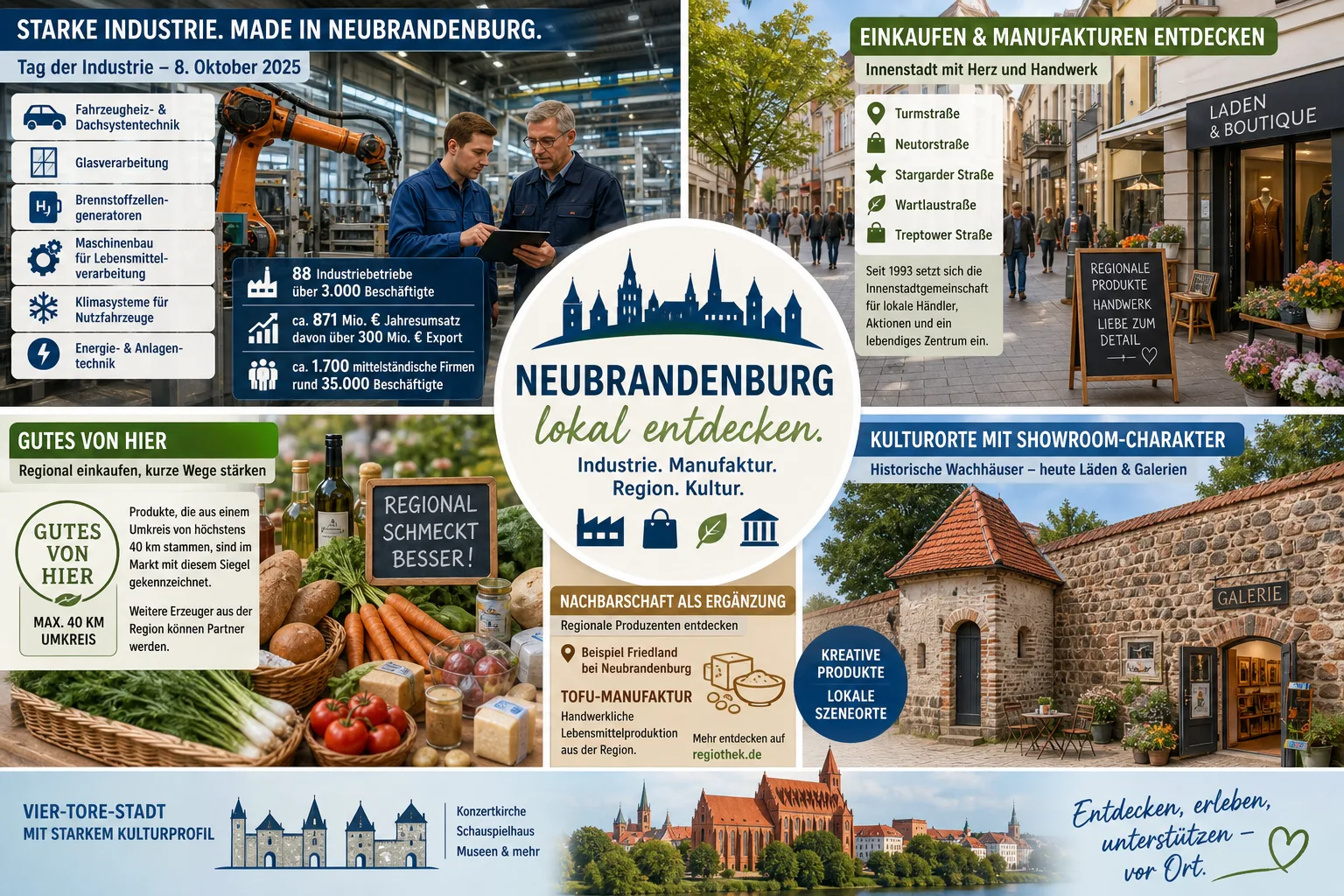
If you want to shop more consciously, give gifts, or simply walk through Neubrandenburg with "different eyes" in the coming weeks, it pays to have a plan: Where will you find regional products, handcrafted small series, and creatively designed one-of-a-kind pieces in the future—without having to click through interchangeable standard goods?
This guide helps you design your next city stroll so that you specifically discover local manufacturers, manufactories, and creative businesses, engage in conversation with them, and support regional value creation.
Why Your Next Purchase Is Especially Worthwhile
Your next purchasing decisions can be more than "just shopping": If you shop locally in the future, you strengthen short supply chains, visible jobs, and a cityscape that doesn't look the same everywhere. At the same time, you often get more transparency: Who made it, what is it made of, how do you care for it, how long does it last?
- More Orientation: You get to know labels, origin information, and quality features that you will recognize in your future purchases.
- More Dialogue: On site, you can ask questions in the future (material, repair, reorder, custom-made) – something that's often difficult online.
- More Character: For future gifts or souvenirs, you will more easily find things that "feel like Neubrandenburg" instead of mass-produced goods.
Route for Your Next City Stroll: Purposefully Walk Through the City Center
For your next walk, it's best to consciously plan time for side streets, shop window details, and short conversations. Instead of just "walking through," you will now go with a searching eye: Where is something designed, refined, repaired, or produced in small quantities?
What to Look Out for Along the Way
- Shop Window Clues: Terms like "handmade," "atelier," "studio," "workshop," "small series," "regional," or "from Mecklenburg-Vorpommern" are often the first anchors.
- Product Transparency: Material information, care instructions, manufacturer name, and place of production are good signals—especially for textiles, wood, ceramics, stationery, or cosmetics.
- Service Offers: Repair, resharpening, modification, or spare parts often indicate durable products and craftsmanship.
- Cooperations: Watch for joint actions ("pop-up," "guest exhibition," "collection drop") – this way you can discover several local labels at once in the future.
Mini-Questions You Can Ask on Your Next Visit
- "Where is this specifically made or refined?"
- "What materials do you use—and why?"
- "Are there care or repair tips to make it last longer?"
- "Does the product come back regularly or is it limited?"
Discover Along the City Wall in the Future: Creative Places That Are Worthwhile
If you walk along the city wall soon, you can turn your walk into a "creative check": Look out for small exhibition spaces, ateliers, galleries, or workshop concepts where you not only see products but often also better understand techniques and materials.
This is especially practical for your next visit if you:
- are looking for a unique souvenir (art, prints, stationery, jewelry, ceramics),
- want to get an insight into manufacturing processes (e.g., surfaces, glazes, printing techniques, wood finishing),
- specifically prefer small series over mass-produced goods.
It's best to plan your visit for times when ateliers are typically open (e.g., late morning or early afternoon). If opening hours vary, check them in advance via the official channels of the respective providers.
Recognize Regional Products on Your Next Weekly Shop: How to Proceed Systematically
Shopping regionally doesn't have to be complicated in the future. The key is that you correctly interpret origin statements: "regional" is not always uniformly defined by law, and terms like "from the region" can mean different things depending on the provider.
Checklist for Your Next Purchase
- Read the Label: Look for specific places/regions instead of just advertising words.
- Have the Manufacturer Named: A clear manufacturer name and address increase traceability.
- Ask Questions: Where was it processed, not just "where did the idea come from"?
- Use the Season: If you plan seasonally in the future, your chances of regional goods increase (especially for fruit/vegetables).
- Classify Seals: EU-protected origin indications (PDO/PGI) have defined criteria; other labels can provide additional orientation but vary in strictness depending on the program.
If a market or retailer uses its own regional label in the future (e.g., with a clearly defined radius), this can improve your orientation. The key is that the criteria are communicated transparently (radius, processing, raw material origin).
Future Occasions Where You Can More Easily Meet Local Makers
If you want to specifically get to know the people behind products in the coming months, events are often the fastest way—especially when they focus on exchange, craftsmanship, culture, or the regional economy.
- City Center Actions & Theme Weeks: When retailer associations or city marketing announce programs, you often find local offers bundled together.
- Art and Culture Formats: At future exhibitions, open studio days, or small markets, you can talk directly with designers.
- Business and Technology Formats: If companies offer factory tours or public days in the future, you get a better sense of what skills and materials are available in the region.
For planning: Preferably check the official event calendars (city, cultural venues, tourist information) and the channels of participating providers so you have reliable information on times, admission, and access conditions.
What You Can Specifically Achieve with Your Next Purchase
- Local Value Creation: When you buy locally in the future, a larger share of spending stays in the region (wages, rents, contracts, training).
- Quality & Durability: Handcrafted products are often designed for use, care, and repair—which can reduce your consumption in the long term.
- Lively City Center: Every conscious decision can help ensure that niche offerings remain and new concepts emerge in the future.
- Cultural Visibility: When you buy local designs, prints, or art in the future, you strengthen creative work as part of the cityscape.
Conclusion: How to See Neubrandenburg Anew on Your Next Visit
If you explore Neubrandenburg soon, you can shift your focus from "checking off sights" to "discovering people & products." Plan a city center walk with time for questions, combine it with a stroll along the city wall, and use a clear regional checklist for your next purchase.
This way, your next stroll becomes a little research into quality, origin, and design—and in the end, you take home not just something, but also a story you can share.